


Fulgora
 Space Age expansion exclusive feature.
Fulgora is a new barren desert planet. Its surface is split between island-like plateaus, and deep oilsands. During the night, the planet is ravaged by lightning storms, damaging buildings.
Planet discovery Fulgora (research) is required to travel to the planet.
Achievements

|
Visit Fulgora Travel to planet Fulgora. |
Exclusive items
Scrap can only be found on Fulgora, in mineable scrap patches or from detritus scattered across the planet. Holmium ore can only be obtained by recycling scrap.
The following intermediates can be crafted off Fulgora, but this requires shipping holmium ore as holmium solution and electrolyte can't be barrelled for shipping:


The following items are unlocked on Fulgora and can only be crafted on-planet:


The following items are unlocked on Fulgora but can be crafted elsewhere:
- Superconductor

- Mech armor

- Personal battery MK3

- Energy shield MK2

- Personal roboport MK2

- Quality module 3

- Tesla turret

Surface
Properties
| Property | Value |
|---|---|
| Pollutant Type | None |
| Day Night Cycle | 3 Minutes |
| Magnetic Field | 99 |
| Solar Power | 20% |
| Pressure | 800 |
| Gravity | 8 |
Biomes
Fulgora is split between two distinct biomes.
- Plateaus are islands dotted around the landscape. They are the only biome where factories can be built. Some plateaus are home to alien ruins as well as fulgoran lightning attractors, which can protect you at night until you build your own lightning rods. Plateaus also hold scrap, Fulgora's sole resource.
- Oil sands or oil oceans are the lowlands between the plateaus. No buildings can be built in them except for rail supports. You can walk through them, but occasional deep oil oceans will slow you to a crawl. An offshore pump can be placed on the edge of oil oceans to produce an unlimited amount of heavy oil.
Oil oceans
Fulgoran terrain is mainly composed of oil oceans, on which nothing except for rail supports can be built. Traversal by foot across the ocean is possible, but slow. The oceans are further divided into deep and shallow areas, with deep areas slowing down player movement even further and not even allowing for rail supports to be built until rail support foundations (research) is researched.
Much later, foundation can be researched, which allows for building on top of the oceans.
Plateaus
The islands come in three size classes:
- Small islands always have a Fulgoran vault ruin, usually other ruins, and a massive amount of scrap in a dense pile.
- Medium islands have a large amount of smaller ruins and usually scattered patches with much smaller amount of scrap.
- Large islands with no resources other than some fulgorite and a few ruins.
It is possible for two or more islands to overlap, potentially creating an even larger island. However, most islands are detached, meaning that transport between islands will have to occur by train. In many cases, the distance between two islands is also too vast for roboports or big electric poles to reach, thus requiring local logistic and electric networks to be built, as neither roboports nor power poles can be built on the oillands without foundation. Islands are often bordered by cliffs, which can make placing rail ramps difficult without access to cliff explosives.
Mechanics
Lightning
During nighttime, dense thunderstorms occur on Fulgora, with frequent lightning strikes occurring across the surface. Each tick a coordinate may become a source of lightning and, if so, lightning will strike within 10 tiles of the source.
Testing shows that lightning storms very likely have the following properties:
- The duration of lightning storms is 90 seconds, spanning half the cycle (during the in-game sunrise and sunset phase as well as night)
- Storms start at 0 intensity and increase in intensity during sunset, hold maximum intensity at night, then decrease in intensity during sunrise(analogous to solar power).
- The expected number of lightning strikes per second within a chunk starts at 0 then increases by 1/18000 each tick up to a maximum of 0.12 strikes per second. Hence, the number of lightning strikes per chunk per tick follows a Poisson distribution with Poisson_parameter(t) = expected_number_of_strikes(t).
- At peak intensity, each chunk is expected to get 0.12 strikes per seconds. This is one strike every 8.33 seconds.
- One can expect 6.48 lightning strikes per chunk per night (or 0.072 strikes per second on average). This follows directly from the properties of Poisson random variables and has been verified empirically. For the vast majority of purposes, treating lightning at night as having constant rate will be accurate enough.
- Taken together this makes the timestamps of lightning strikes able to be modeled as an inhomogenous Poisson point process. However such detailed modelling is unnecessary.
Individual lightning strikes likely have the following behavior:
- If a lightning strike is to generate, a tile/coordinate is chosen as the source. A target for the lightning strike is then chosen within
lightning_reachtiles based on priority and lightning attractors nearby. lightning_reach= 10.- Any lightning with a source that is within
rangemeters of a lightning attractor (i.e. a Fulgoran lightning attractor, a lightning rod, or a lightning collector) will count that attractor as a valid target. Since lightning attractors have the highest priority, this ensures strikes within range of a lightning attractor will always hit the attractor (or an attractor if multiple are nearby). Keep in mind lightning attractor range is:building_reach + lightning_reach - Lightning will prefer striking the entity with the highest priority, choosing randomly between entities tied for highest priority.
- Lightning deals 100 electric damage to struck entities.
- Lightning strikes contain 1 GJ of energy that can be used to charge lightning attractors
| Entity | Priority value |
|---|---|
 |
10,000 |
 |
1,000 |
| Fulgoran lightning attractor | 1,000 |
| Fulgoran vault ruin | 95 |
| Colossal Fulgoran ruin | 94 |
| Huge Fulgoran ruin | 93 |
| Big Fulgoran ruin | 92 |
| Medium Fulgoran ruin | 91 |


| Entities | Category |
|---|---|
Legacy rail    |
Rail pieces |
  |
Rail signals (notably not train stops) |
    |
Trains |
  |
Walls and mines |
   |
Trees and entities that count as a rock for filtered destruction |
Lightning rods and collectors
Lightning rods and lightning collectors serve a secondary function beyond protecting an area from lightning strikes. They convert lightning into stored power, which they quickly discharge into the local electric system. With enough accumulators to last during daytime or between lightning strikes, this can serve as the factory's main power source.
With this, lightning on Fulgora becomes both a curse and a blessing: players must keep their factory covered by lightning rods or collectors to avoid damage, and nighttime exploration becomes dangerous and risky. However, to an established base, lightning become a convenient source of electric energy, which is especially important given the weak solar output on Fulgora's surface and the difficulty of setting up a global electric network on Fulgora before foundation becomes available.
Natural resources
Aside from numerous items that can be collected by mining ancient ruins, only two "natural" resources occur on Fulgora, those being heavy oil and scrap.
Heavy oil can be obtained in infinite and non-diminishing amounts by placing an offshore pump on the shore of an island, allowing it to collect heavy oil directly from the oillands.
Scrap is found in deposits on small and medium sized islands, as if it were an ore. However, in stark contrast to most other natural resources, scrap is not directly processed into a single basic resource like iron or copper plates using traditional production methods. Rather, it is recycled to produce a variety of items. Players can also recycle by hand provided the recipe has been unlocked.
| Input | Output | Chance | Rate |
|---|---|---|---|
 |
 |
20% | 0.5/s |
 |
7% | 0.175/s | |
 |
6% | 0.15/s | |
 |
5% | 0.125/s | |
 |
4% | 0.1/s | |
 |
4% | 0.1/s | |
 |
4% | 0.1/s | |
 |
3% | 0.075/s | |
 |
3% | 0.075/s | |
 |
2% | 0.05/s | |
 |
1% | 0.025/s | |
 |
1% | 0.025/s |
Since this list includes intermediate products, such as processing units, but no iron or copper plates, players are generally forced to further recycle many of these items in order to obtain their ingredients. Players are thus left with the decision of what items to recycle, all while having to avoid cluttering their belts with unused resources.
Access to basic resources
- Water can be obtained from ice (from recycling scrap) via ice melting
- Stone can be obtained by recycling scrap
- Iron ore can be obtained by recycling concrete
- Iron plate can be obtained by recycling iron gear wheel, battery, or electronic circuit
- Copper plate can be obtained by recycling copper cable, battery, or low density structure
- Coal cannot be obtained and must be shipped in from other planets. However:
- Plastic bar can be obtained by recycling advanced circuit or low density structure
- There are no enemies on-planet, so explosives-based ammunition or grenades are not needed
- Crude oil is not available, but heavy oil is readily available using offshore pumps
- Copper ore is not available as the only recipe it is used in is copper plates and smelting processes cannot be reversed
- Uranium is not available eliminating nuclear power without importing from off planet
Power Considerations
Lightning Power
Main Article: Power production#Lightning power
Roughly speaking, placing lightning rods as needed for coverage will provide more than enough power at night unless one has end-game bases with very high power-density. Lightning rod #Net Efficiency has information relevant for realistic power-densities that can be maintained sustainably with lightning power.
Since lightning only occurs at night, one must use accumulators to make lightning energy available during the day. If not using any other source of power during the day, one should place enough accumulators to cover ~60% of the day's duration to be safe. For every 1 MW of base demand, this is 108 MJ of storage (22 - 4 accumulators per MW depending on quality). Note that accumulators add extra load to the grid at night (0.3 - 0.75 MW per accumulator depending on quality). This is actually beneficial as it reduces the lightning energy lost to the drain mechanic.
Alternative Power
The lightning mechanic offers free electricity, but this is not always adequate on its own and it may be desirable to setup auxiliary or backup power for when accumulators run low. The primary considerations or limiting factors to setting up power generation are water from ice, and physical space due to the lack of usable land on the surface.
Solid Fuel Burning:
Using boilers with solid fuel offers 0.3 MJ per unit of water, and offers an energy density of ~0.05 MW per tile of surface area (36 tiles for two steam engines and a boiler). Using a heat exchanger offers 0.97 MJ per unit of water and offers an energy density of around 0.3 MW per tile (depending on layout), making it ~6x more space efficient and 3.2x more water efficient.
If using native Scrap output ratios and no productivity on ice to water, one can obtain 7 solid fuel per 100 units of water per 100 scrap. This yields:
- Via boilers: 84 MJ from solid fuel, 30 MJ from water. Thus only 35% of solid fuel can be used.
- Via heating tower + heat exchangers: 210 MJ from solid fuel, 97 MJ from water. Thus only 46% of solid fuel can be used.
Water Production
1 unstacked blue belt is 45 scrap per second. If run during only 50% of the day, this means each blue belt can provide at most 27 MW (via steam engines) or ~87 MW (via steam turbines) of power during the day without productivity on either scrap output or ice to water. Keep in mind that most Fulgora setups require some water so this is only an upper bound, not an estimate of what is sustainable. When recycling scrap becomes output bound, one is limited to 45MW and 145MW respectively per blue belt of scrap output. With normal productivity module 3s on ice to water this can rise to 58.5 MW and ~190 MW respectively.
Water can also be imported from off planet if supply is a significant issue. But since power demand is correlated with scrap processing, it is unlikely that this will be necessary. For example, 240 scrap-output per second (1 stacked turbo belt of gears, solid fuel, ice, etc.) provides enough ice for at most 1 GW of power generation during the day:
240 output/sec x 0.0833 ice/output x 20 water/ice x 1.3 (productivity) x 2 (run half the day) = ~1040 water/sec in daytime --> ~1 GW power
Other Info
Regarding heat production, heating towers offer ~4.4 MW per tile, making them initially superior to nuclear at 1.6 MW per tile for a single reactor, but at scale due to the neighbor bonus nuclear can achieve higher energy density. Any reactor array larger than 1x2 will effectively achieve a higher energy density than heating towers. However excess heat from a reactor must be stored in either extra heat pipes or steam which will significantly reduce the power density. The reactor will also need uranium or uranium fuel cells imported.
Solar panels do not require any water, but receive an 80% penalty on Fulgora, producing only 12 kW, or ~1.3 kW per tile. Note this is in kW, not MW. Given that fuel is abundant and space is limited and water is not impossible to acquire, this makes solar effectively worthless on Fulgora.
For reference, normal accumulators discharging their entire energy reserve over ~60% of the day will only output 0.045 MW and will take up 4 tiles for ~0.011 MW per tile. Even legendary accumulators will only have a power-density of ~0.07 MW per tile. This is far below the steam-based power above.
To recap:
- Non-accumulator power is constrained by ice availability.
- Heat Exchangers are ~3x more water efficient than boilers
- Solar panels should be avoided, effectively replaced by lightning
- Accumulators are significantly less power-dense than steam-based energy sources.
Optimization Tips
Fulgora has no pollution mechanic, and an overabundance of fuel. If electricity problems arise due to lack of power generation, burners are significantly more viable on Fulgora than in the base game and can help ease electrical consumption. Using burner miners, burner inserters, and steel furnaces can significantly ease electrical consumption as long as modules aren't required and throughput doesn't become an issue. This also helps use up excess solid fuel
Space routes
Fulgora is connected to 3 other planets: Nauvis, Gleba, and Aquilo.
| Planet | Distance (km) |
|---|---|
| Nauvis | 15,000 |
| Gleba | 15,000 |
| Aquilo | 30,000 |
Asteroid rate graphs:
 Space route from Nauvis to Fulgora |
 Space route from Gleba to Fulgora |
 Space route from Fulgora to Aquilo |
Graph legend:
| Asteroid type | Chunk | Medium | Big |
|---|---|---|---|
 Metallic Metallic |
● Blue | ● Red | ● Cyan |
 Carbonic Carbonic |
● Orange | ● Yellow | ● Brown |
 Oxide Oxide |
● Green | ● Magenta | ● Purple |
Orbit
Properties
| Property | Value |
|---|---|
| Solar Power | 120% |
| Asteroid Type | Spawn Ratio |
|---|---|
| Metallic asteroid chunk | 4 |
| Carbonic asteroid chunk | 3 |
| Oxide asteroid chunk | 1 |
| Promethium asteroid chunk | 0 |
| Asteroid Size | Spawn % |
|---|---|
| Chunk | .25 |
| Medium | .25 |
| Big | 0 |
| Huge | 0 |
Note:
- Chunks spawn at Nauvis at 1.25%
- Huge Asteroids only spawn past Aquilo
Gallery
-
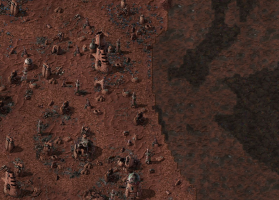 Example landscape of Fulgora.
 -
 Fulgora seen on the expansion's title screen.


Trivia
- The planet's ruins suggest that an unknown civilization once existed there before the game's events.
- In mythology, Fulgora is the Roman personification of lightning, and a shieldmaiden to the god of thunder, Jupiter.
- The planet is based on real-world desert planets, as well as lightning observed on other planets like Jupiter, Saturn, Uranus, and Neptune.


