

Thruster
  |
Thruster |

|
Recipe |
|||||||||||||
    |
|||||||||||||
|
Total raw |
|||||||||||||
|
|
|||||||||||||
|
Map color |
|||||||||||||
|
Health |
|
||||||||||||
|
Stack size |
10 |
||||||||||||
|
|
5 |
||||||||||||
|
Dimensions |
4×8 |
||||||||||||
|
Power output |
|
||||||||||||
|
Fluid consumption |
|
||||||||||||
|
Mining time |
0.1 |
||||||||||||
|
Prototype type |
|||||||||||||
|
Internal name |
thruster |
||||||||||||
|
Required technologies |
|||||||||||||
 |
|||||||||||||
|
Produced by |
|||||||||||||
    |
|||||||||||||


 Space Age expansion exclusive feature.
Thrusters are components of space platforms that propel the platforms through space, and to other planets. Thrusters require both thruster fuel and thruster oxidizer to function. Thrusters can only be built on the south edge of a space platform, with nothing directly south in the path of their exhaust. This placement means space platforms always travel north toward the top of the screen.
Thrusters are operated via the space platform hub. When a destination is set and the switch set to "Automatic," thrusters turn on and move the platform toward its destination. They turn off by themselves when the destination is reached. Moving the switch back to "Paused thrust" will turn all thrusters off immediately.
Speed and acceleration are affected by the number of thrusters, their efficiency, and the mass of the platform. Thrusters are at their least efficient when they have full reserves of both fuel and oxidizer, but produce higher speed and acceleration. Partly empty reserves cause them to work more efficiently, as noted in the table below, at the expense of speed/acceleration.
Depending on speed, damaging asteroids are encountered in greater numbers. This means that defenses should be built before turning on the thrusters, and high thrust requires stronger defense.
General principles
The equations behind thruster performance are a bit complex (see below), so here are some guidelines for platform design:
- Platform width is far more important than mass in determining top speed (and therefore travel time).
- Adding more thrusters is not worthwhile if wider platform is required.
- Thrust has diminishing returns in either thrusters or fuel, unless both of them are added.
- Minimum total fuel volume is achieved at low speeds.
Shape design
Platform drag, which limits the top speed achievable with a given thrust, is strongly dependent on the width of the platform (in tiles) and much less dependent on the total mass of the platform.
-
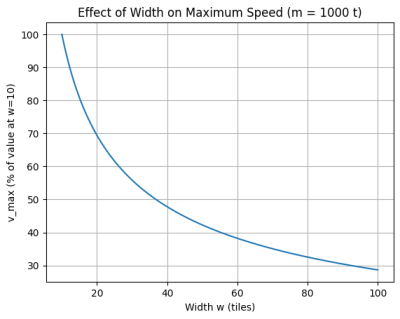 Top speed drops off precipitously as width of the platform increases.
 -
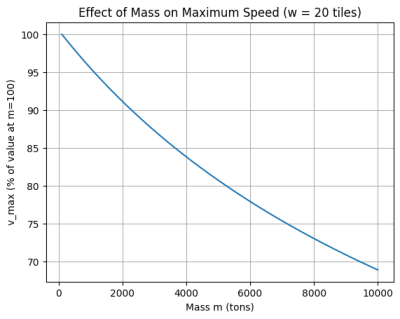 Top speed reduces by only 30 percent with a hundredfold increase in mass.


Travel time is also slightly affected by mass (a few percent) due to the longer time taken to get up to maximum speed, but most of the journey is done at top speed and so travel time is dominated by width. This encourages long, narrow rocket-like platform designs for interplanetary travel.
When considering how many thrusters to install on a platform of a certain width, the optimal number of thrusters is as many as will fit without making the platform wider. This is because the additional drag from the extra width cancels out the additional thrust from the extra thrusters. For a fixed fuelling rate, making the platform wider to add more thrusters actually makes it slower.

For example, for a platform with a width of 32 tiles, the maximum speed is attained with 8 thrusters since each thruster is 4 tiles wide. Note that this does not apply if more thrusters can be added without increasing the width of the platform by stacking multiple thrusters vertically.
Marginal diminishing effect of thrust
Because thrusters increase efficiency with lower fuel, thrust can be increased by adding either fuel or thrusters alone, but with diminishing returns. To get linear gains, both of them need to be increased proportionally.
-
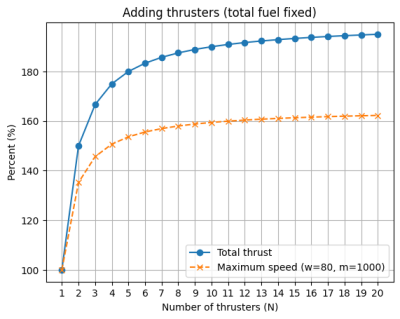 Adding thrusters at a fixed fuel rate increases both thrust and speed, but with strong diminishing returns.
 -
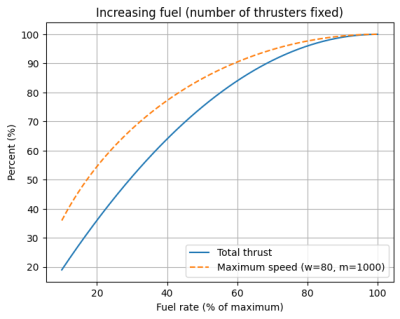 Increasing fuel to a fixed number of thrusters raises thrust and speed, but each extra percent of fuel gives a smaller gain than the last.
 -
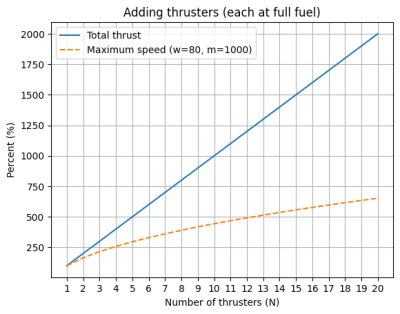 With full fuel per thruster, thrust scales linearly with thruster count, while speed increases with some diminishing returns due to drag.


Fuel saving
If no fuel is replenished or manufactured during the flight, but instead the whole journey is completed relying on pre-stored fuel on board, it is necessary to minimize the total fuel volume consumption for a given trip. In general the slower the flight speed, the less the total fuel consumption, as the greater efficiency of the thrusters more than cancels out the longer travel time.
-
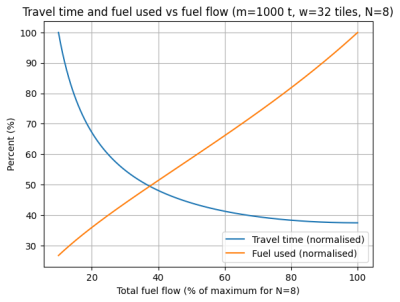 For a typical platform, total fuel used increases steadily with fuel flow, so the least fuel is consumed at the lowest throttle, even though travel time is longest.
 -
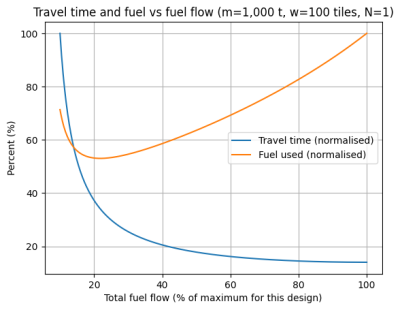 On a wide, low-thrust platform, the slowest speed is so slow that it takes less fuel overall to go slightly faster.
 -
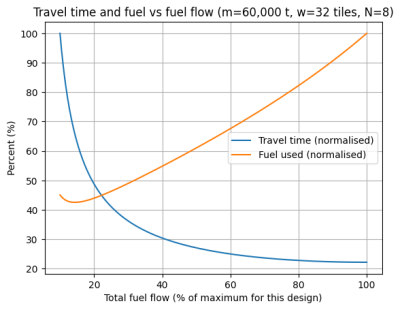 On an extremely heavy platform, total fuel used also has a shallow minimum at low, but not minimum throttle.


The exceptions are for platforms with few thrusters and a lot of drag, or very heavy platforms, where the slowest speed is so slow that it takes less fuel overall to go slightly faster. The optimal fuelling rate in these cases is still generally 15-25% though.
Details
Datasheet
The "Relative thrust" and "Relative fluid consumption" is the percentage for the range of a thruster of that quality. 50% relative thrust is halfway between the minimum thrust and the maximum thrust. For a base quality thruster, 50% is 55.95 MN, while for a legendary thruster, it is 139.45 MN, a 150% increase.
| Filled fluid reserve | Efficiency | Relative thrust | Relative fluid consumption | Fluid consumption (units/s) | ||||
|---|---|---|---|---|---|---|---|---|
 Normal Normal |
 Uncommon Uncommon |
 Rare Rare |
 Epic Epic |
 Legendary Legendary
| ||||
| 0% | 100% | 10% | 10% | 6.00 | 7.80 | 9.60 | 11.40 | 15.00 |
| 5% | 100% | 10% | 10% | 6.00 | 7.80 | 9.60 | 11.40 | 15.00 |
| 10% | 100% | 10% | 10% | 6.00 | 7.80 | 9.60 | 11.40 | 15.00 |
| 15% | 97% | 22% | 24% | 14.14 | 18.39 | 22.63 | 26.87 | 36.00 |
| 20% | 93% | 34% | 37% | 22.29 | 28.97 | 35.66 | 42.34 | 55.50 |
| 25% | 90% | 44% | 51% | 30.43 | 39.56 | 48.69 | 57.81 | 76.50 |
| 30% | 86% | 54% | 64% | 38.57 | 50.14 | 61.71 | 73.29 | 96.00 |
| 35% | 83% | 63% | 78% | 46.71 | 60.73 | 74.74 | 88.76 | 117.00 |
| 40% | 79% | 71% | 91% | 54.86 | 71.31 | 87.77 | 104.23 | 136.50 |
| 45% | 76% | 78% | 105% | 63.00 | 81.90 | 100.80 | 119.70 | 157.50 |
| 50% | 72% | 84% | 119% | 71.14 | 92.49 | 113.83 | 135.17 | 178.50 |
| 55% | 69% | 89% | 132% | 79.29 | 103.07 | 126.86 | 150.64 | 198.00 |
| 60% | 65% | 93% | 146% | 87.43 | 113.66 | 139.89 | 166.11 | 219.00 |
| 65% | 62% | 96% | 159% | 95.57 | 124.24 | 152.91 | 181.59 | 238.50 |
| 70% | 58% | 98% | 173% | 103.71 | 134.83 | 165.94 | 197.06 | 259.50 |
| 75% | 55% | 100% | 186% | 111.86 | 145.41 | 178.97 | 212.53 | 279.00 |
| 80% | 51% | 100% | 200% | 120.00 | 156.00 | 192.00 | 228.00 | 300.00 |
| 85% | 51% | 100% | 200% | 120.00 | 156.00 | 192.00 | 228.00 | 300.00 |
| 90% | 51% | 100% | 200% | 120.00 | 156.00 | 192.00 | 228.00 | 300.00 |
| 95% | 51% | 100% | 200% | 120.00 | 156.00 | 192.00 | 228.00 | 300.00 |
| 100% | 51% | 100% | 200% | 120.00 | 156.00 | 192.00 | 228.00 | 300.00 |
Formulas
- acceleration. Change of speed per tick.
where:
- w - width of a platform, in tiles
- m - mass of a platform, in tons
- v - speed parameter, in km/s, can't be below zero. Actual current speed of a platform is v-10 in first half and v+10 in the second half of a trip.
- - thrust, in MN.
As formulas above, the drag increases quadratically with velocity, like in real world when moving through low density gas. When drag becomes equal to thrust force, acceleration stops, a platform hits its top speed. Another important detail is that drag hence top speed depends not on the mass of a platform, but its width. Mass is still a factor of how fast the top speed can be reached though. The second term of drag is negligible for ordinary platforms and exist to punish extra massive platforms by effectively cutting a piece of thrust force. For a platform of 1000 tons 10% of thrust force is lost.
That formulas combined give
plus/minus 10 for actual maximum speed.
The amount of thrust force in MN created by a single thruster is described well in in-game wiki. Multiple sources of thrust stack additively.
Trivia
- The color of the thruster trail changes depending on the amount of fuel and oxidizer in the thruster, becoming blue when fuel is low or red when oxidizer is low.
- The thruster exhaust trail is 82 tiles long. Structures cannot be placed in the exhaust trail. This means that the total dimensions where the thruster blocks placement of other structures is 4×90 tiles. However, structures can be placed directly behind the end of the trail.
Gallery
-
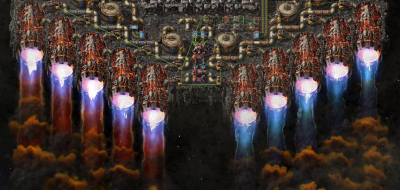 Thruster trail turns red when fuel amount is higher than oxidizer (left) and blue when oxidizer is higher (right)
 -
 Thruster trails are visible on the zoomed-out map view


